In the test: This is how the Kia EV6 facelift (2025) drives
What makes the Kia EV6 stand out?
The Kia EV6 electric crossover has been on the market since 2021. The EV6 was one of the first electric cars to be equipped with 800-volt fast-charging technology. Thanks to this technology, higher charging capacities of the battery can be achieved – and charging times can be significantly reduced. To highlight the special technology of the EV6, the design department gave it an extraordinary look that is somewhere between a sporty station wagon and an SUV. At the end of 2024, the EV6 will now receive a comprehensive facelift.
The Kia EV6 facelift (2025) in review
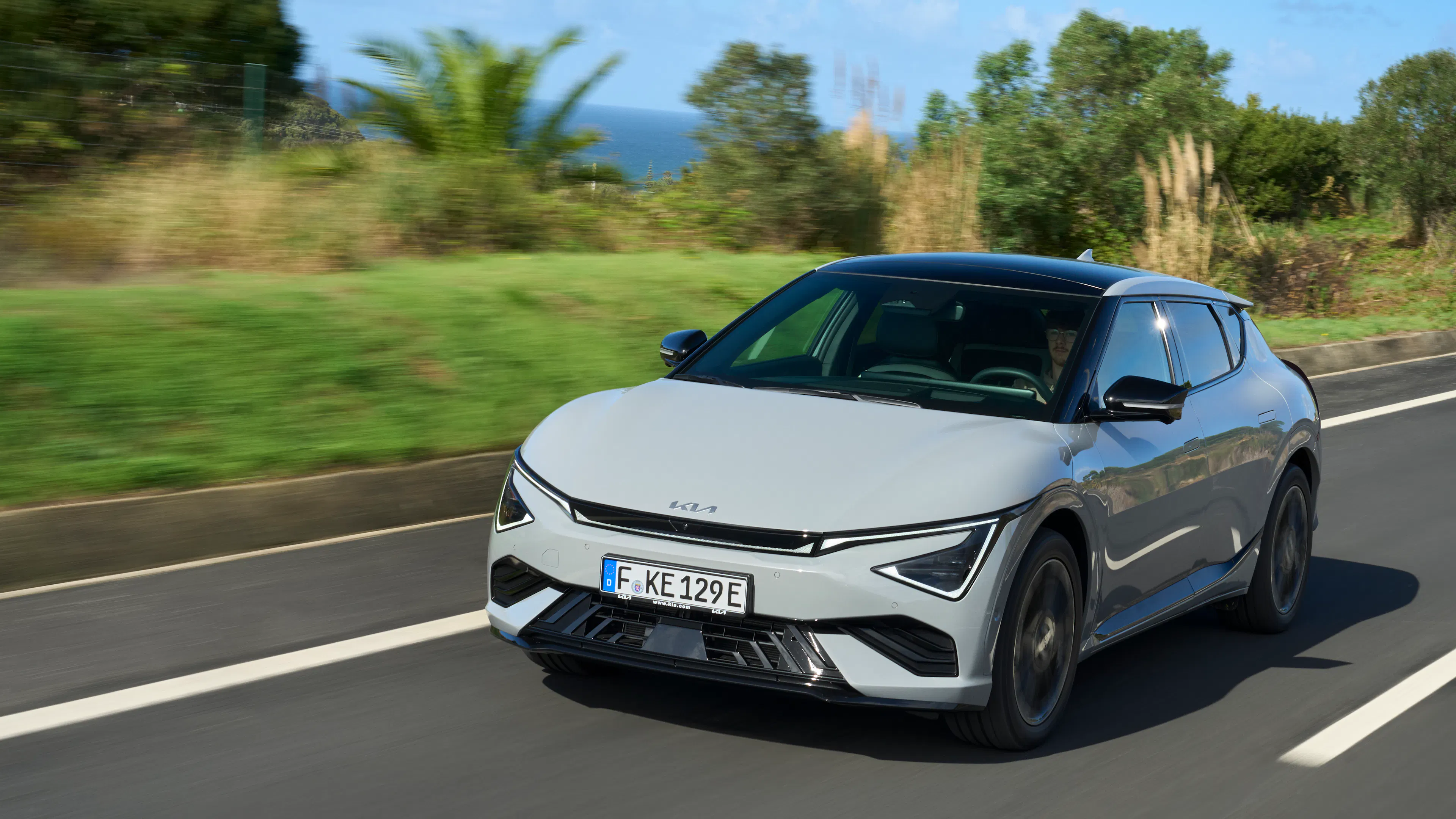
Driving in the Kia EV6 facelift is very pleasant. On board our test car are the larger 84 kWh battery and two electric motors. Together, they have a peak output of 239 kW (325 hp) and deliver up to 605 Newton metres of power under the driver's right foot. With this engine, the EV6 facelift as an AWD variant is supposed to accelerate from a standstill to 100 km/h in 5.3 seconds. In view of the enormous power that the wolf-gray specimen offers, there is no doubt about it. As far as the driving values are concerned, however, nothing has changed with the facelift - but it has changed with the chassis.
A new damper tuning is supposed to make the EV6 more comfortable. On the sometimes quite undulating roads on which the test drive takes place, I can only confirm this information, whereby the balance of the chassis is particularly noteworthy; the EV6 swallows smaller and larger bumps, but still makes an alert impression on the chassis side. If you want, you can take corners cleaner and more willing than the dimensions and mass (a good 2.1 tons) of the EV6 would suggest.
Outwardly different, technically related
The technical platform on which the Kia EV6 is based is called E-GMP. The angular Hyundai Ioniq 5, the streamlined Hyundai Ioniq 6, the Genesis GV60 and the much larger SUVs Ioniq 9 and Kia EV9 are also based on this architecture. As different as they may look, what they all have in common is the 800-volt technology for particularly fast charging.
The modulation of the brakes has improved with the facelift, the interaction of recuperation and mechanical braking is more harmonious, and the steering also leaves a positive impression. In the test of the Kia EV6, it achieves a good compromise between direct response and playful everyday comfort without excessive effort when operating. The noise level is low – but I can only speculate whether it is due to the new insulation.
According to Kia, improved control performance should also make the lane keeping and lane following assistant more sensitive. And yes, the help with lane keeping and the associated steering intervention takes place on my test drive as a discreet course correction.
The engines of the Kia EV6 Facelift
| Engine | Drive | Accumulator | Achievement | WLTP consumption/100 km | WLTP range |
|---|---|---|---|---|---|
| Kia EV6 RWD | Rear-wheel drive | 63 kWh | 125 kW (170 hp) | 16.4 kWh | 428 km |
| Kia EV6 RWD "Long Range" | Rear-wheel drive | 84 kWh | 168 kW (229 hp) | 15.9 kWh (19 inches) and 16.9 kWh (20 inches) | 582 km (19 inches) and 560 km (20 inches) |
| Kia EV6 AWD | All-wheel drive | 84 kWh | 239 kW (325 hp) | 17.0 kWh (19 inches) and 17.7 (20 inches) | 546 km (19 inches) and 522 km (20 inches) |
What changes visually with the facelift of the Kia EV6?
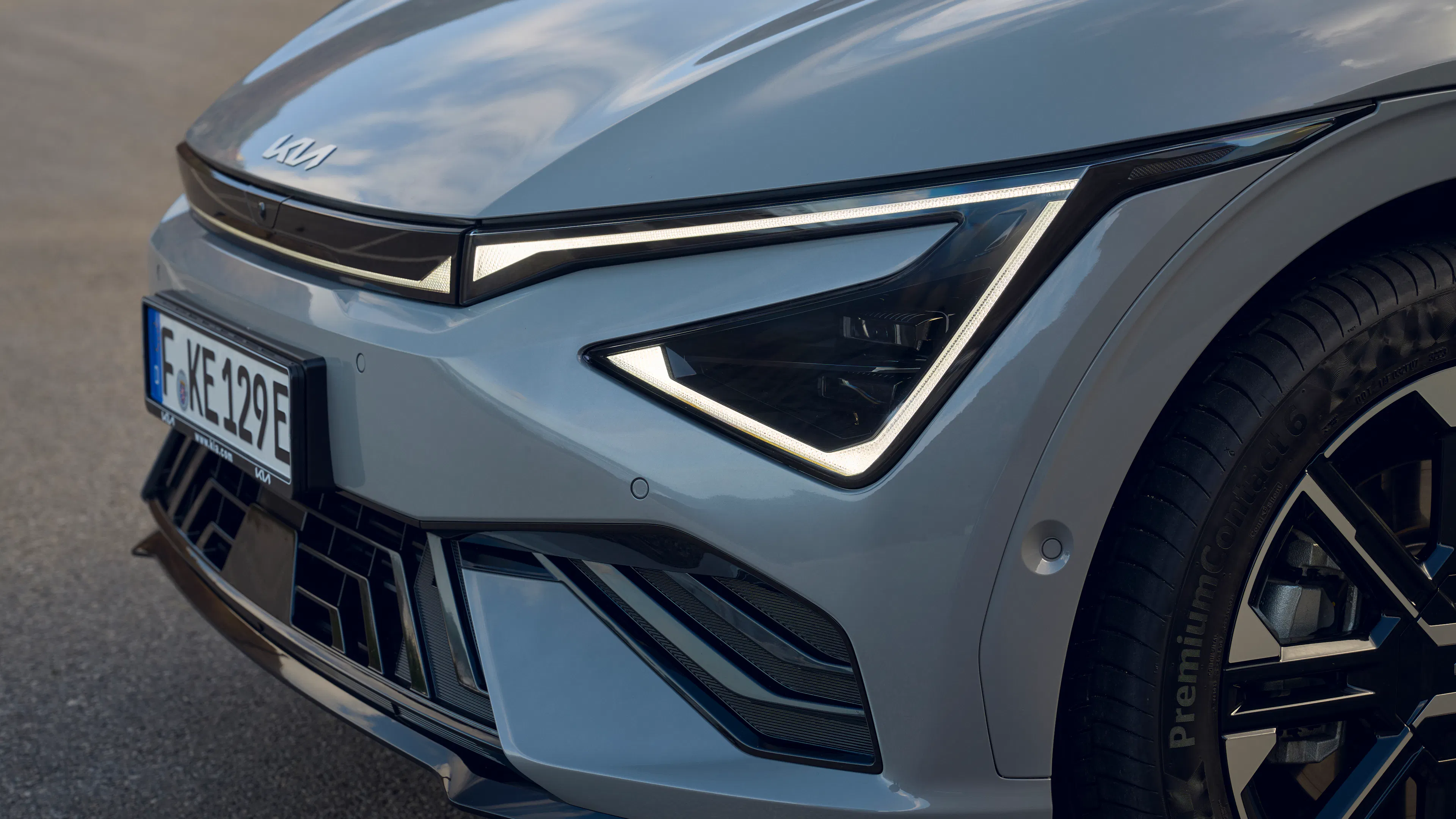
The new front end of the EV6 is easy to recognize. Especially around the headlights, the designers have adapted the crossover more closely to the other electric models. In addition to the new headlights and the continuous, serrated light strip in the style of the EV9, the EV6 wears a modified apron, which finds its visual counterpart at the rear. At the rear, the taillights are slightly modified and have a different brake light signature. The refreshed look is rounded off by two new paint colours (Wolf Grey and Yacht Blue matt, followed later by ivory) and new rims (19 and 20 inches).
How much range does the Kia EV6 have after the facelift?
Secretly, the facelift brings with it a number of technical changes. The basis and the 800-volt fast-charging technology will be retained in principle – but will be improved in detail. The new batteries now have a higher energy density: The capacity of the smaller battery increases from 58 kWh to 63 kWh with the facelift. This increases the range to up to 428 kilometres according to WLTP. The larger battery now stores 84 kWh instead of 77.4 kWh. Kia has been able to increase the range by ten percent: up to 582 kilometers with rear-wheel drive, or up to 546 kilometers with all-wheel drive.
What is the charging power of the Kia EV6 after the facelift?
The charging capacities of the energy storage systems have also been increased. The small battery now charges with up to 195 kW (plus 15 kW) and the large one with up to 258 kW (plus 18 kW). The increased charging capacity makes it possible to recharge up to 343 kilometres in 15 minutes. Despite the increased capacity of the batteries, the Kia EV6 should charge from 10 to 80 percent SOC (State of Charge) in 18 minutes in the best case. In addition, Kia claims to have significantly smoothed the charging curve above 80 percent SOC.
What are the new features of the Kia EV6 facelift?
New in the facelifted EV6 is the "Plug & Charge" function for particularly simple and smooth charging processes. And in the infotainment, manual preconditioning has been added, which can be used to prepare the battery for maximum charging power at the fast charger, even if no route is programmed or you want to use a spontaneous stop for DC charging.
How much does the Kia EV6 facelift cost?
The pricing of the Kia EV6 facelift is pleasing, because the entry-level price drops – untypically – with the model revision. The EV6 is the entry-level with the enlarged 63 kWh battery and rear-wheel drive (WLTP range: 428 kilometres) for 44,990 euros. With the large 84 kWh battery (WLTP range: up to 582 kilometres), at least 49,990 euros are due, and those who want to call the 325 hp all-wheel-drive version of the EV6 their own must be prepared for at least 53,990 euros.
What are the dimensions of the Kia EV6 facelift?
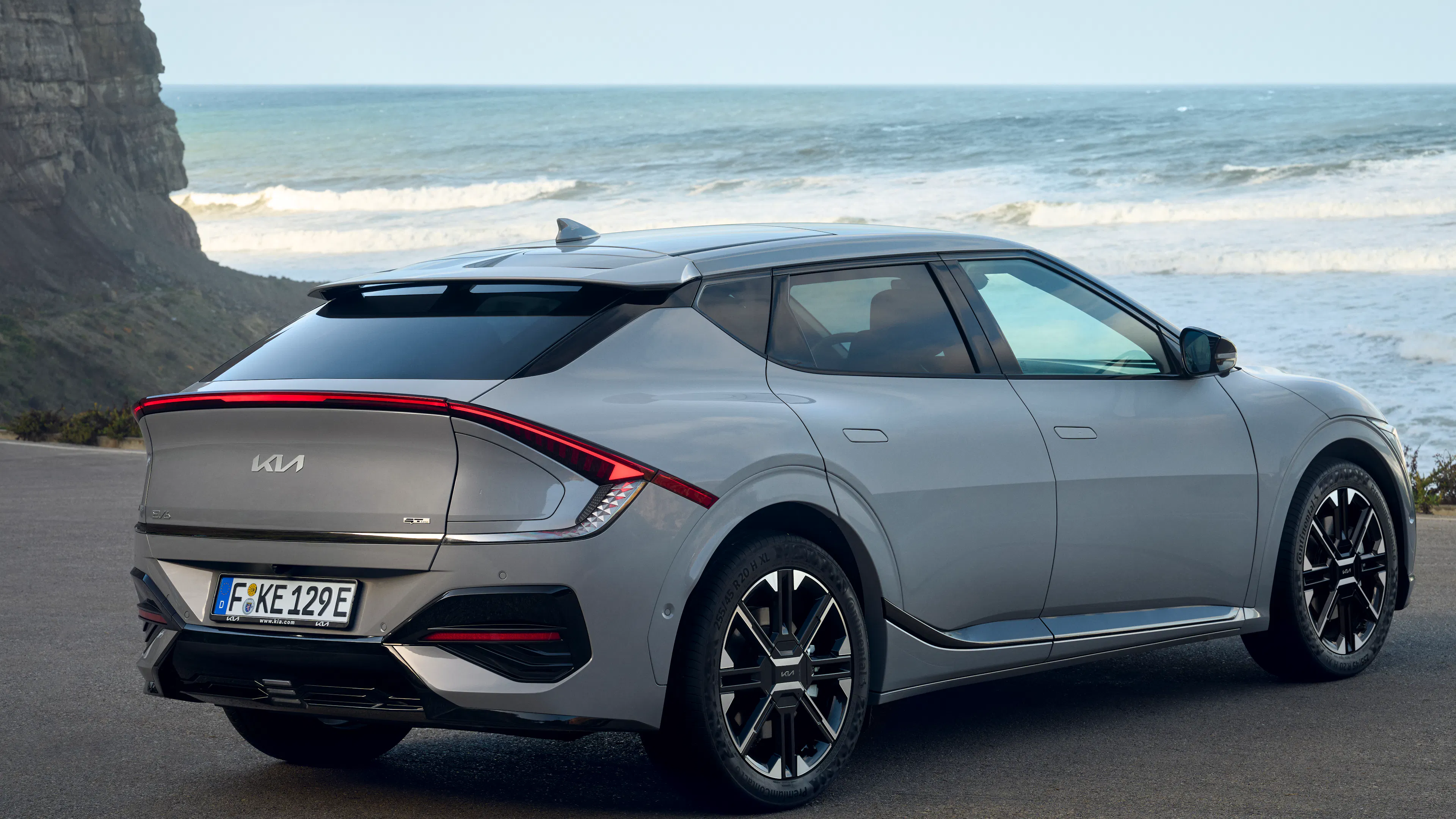
The dimensions of the EV6 remain largely untouched with the facelift, the basic model is now just as long as the GT-Line with 15 millimeters more length. With a length of a good 4.70 meters and a width of 1.88 meters, the EV6 is a stately electric car.
- Length: 4.70 meters
- Width: 1.88 meters
- Height: 1.55 meters
- Wheelbase: 2.90 meters
How much luggage can I store in the Kia EV6 Facelift?
The boot volume of the EV6 remains unchanged at 490 litres even after the update. If you fold down the rear seat backrest, 1,290 liters are available. In addition, there is a frunk under the bonnet. In the rear-engine versions, it has a capacity of 52 litres, while in the all-wheel-drive version of the EV6, 20 litres can be stowed in the front luggage compartment. The increased towing capacity of the long-range variant (84 kWh RWD) is new: before the facelift it was 1.6 tonnes, after the facelift it is 1.8 tonnes.
What's new in the interior of the Kia EV6 facelift?
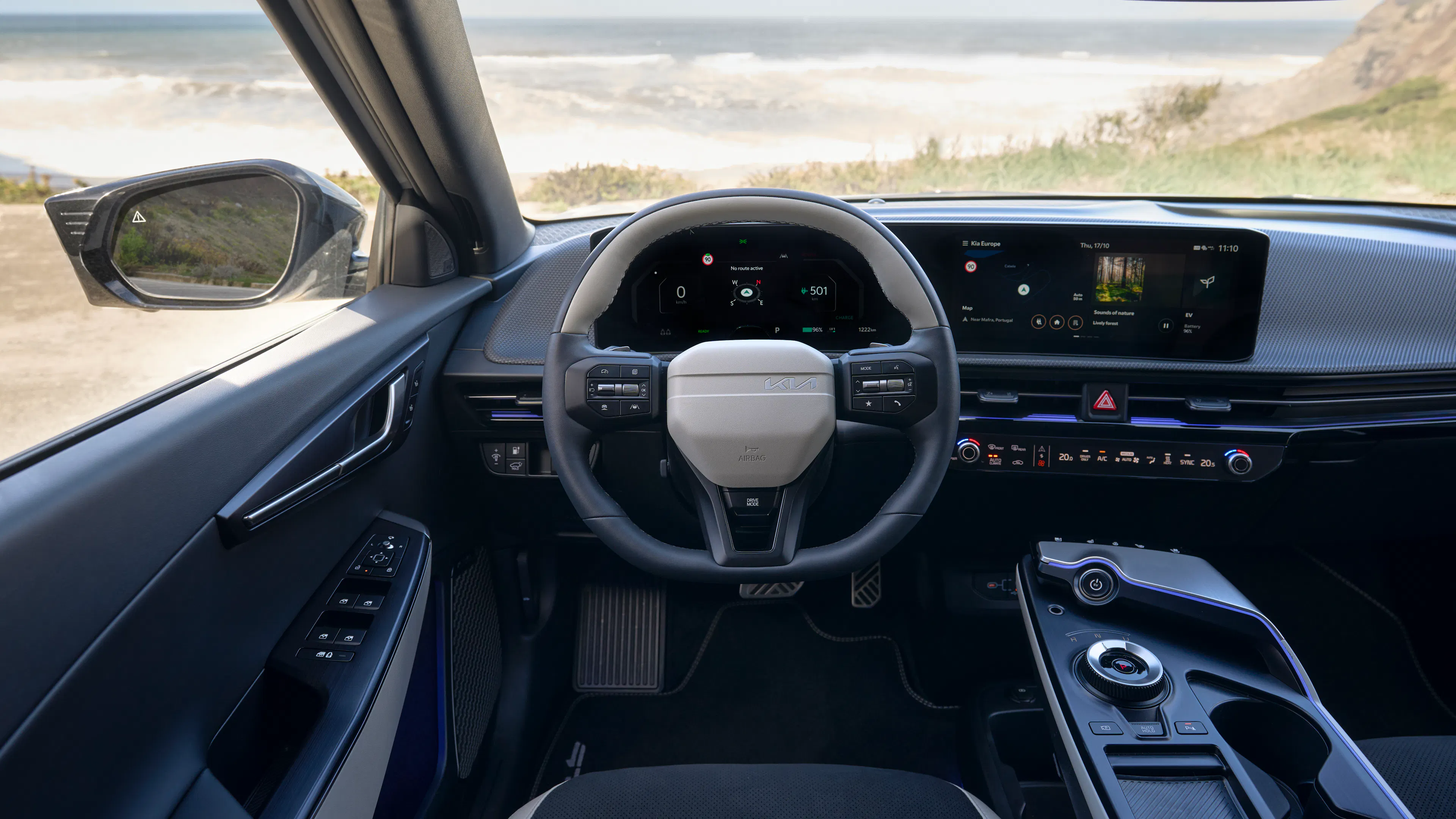
In the interior, the first thing you notice is the new steering wheel of the EV6. This is available in two versions – with two or three spokes, depending on the equipment line selected. Positive: The buttons are standard, the operation intuitive and flawless. Kia has even thought of muting the prescribed speed limit warning - simply hold down the volume roller on the steering wheel, and the speed chauffeur is silent.
The rest of the revisions are also quite pleasing. Kia has deleted the scratch-sensitive piano lacquer look on the center console. The new infotainment supports wireless Apple CarPlay and Android Auto, and the inductive charging cradle has more power, now charging with 15 watts instead of 5 watts, but without cooling. The ambient lighting now adapts in its graphics to the headlights or taillights, and there is a fingerprint scanner on the center console, so you can start the EV6 without a key, provided you have been unlocked beforehand.
The pros and cons of the Kia EV6 facelift
Strengthen
-
Fast charging technology and the large battery make the EV6 suitable for long distances
-
Balanced chassis and powerful acceleration
-
Comfortable space for passengers
Weaken
- Relatively small trunk compared to the size of the vehicle
My conclusion on the Kia EV6 facelift (2025)
The term "facelift" doesn't quite apply to the EV6 – it doesn't go far enough. Because with the model revision, Kia has not only further developed the 800-volt crossover in terms of looks. Detailed improvements to charging power, battery capacity, infotainment and charging management sharpen the EV6 in a meaningful way. And so the EV6 becomes even more convincing with the comprehensive update. All the more sympathetic that the prices were even lowered with the revision.
Posting Komentar untuk "In the test: This is how the Kia EV6 facelift (2025) drives"